-
 Jason-Flor Sisante has always been enamored by outer space. Now, as a member of the United States Navy's aerospace medicine program, he hopes to take his talents as a medical professional into the cosmos.
 -
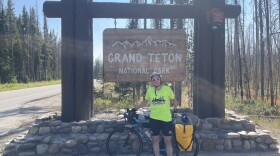 Starting in Seattle, Washington, Dr. Friedrike Benning biked over 2,000 miles before her first day as a fellow at the Stowers Institute for Medical Research. Along the way, she discovered how her work as a researcher reflected her journey as a cyclist.
 -
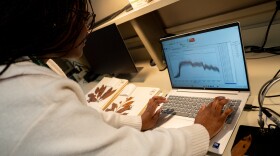 An anonymous $14 million grant to the Missouri Botanical Garden is prompting scientists there to look at their herbarium collection in new ways, taking their cues from the stars.
 -
 In "Footeprint," out today, Lindsay Metcalf resurrects the history of Eunice Newton Foote, a 19th-century scientist who discovered carbon dioxide’s heat-trapping properties while fighting for women’s place in science.
 -
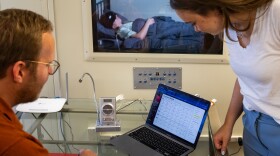 Dr. Westley Youngren, an assistant professor of psychology at the University of Missouri-Kansas City, is researching ways to treat nightmares caused by trauma or PTSD.
 -
 A data center in the Crossroads is one of the first in the country to get a loan for clean energy. Plus: Scientists across the central U.S. say they have experienced a year of change and uncertainty under the second Trump administration.
 -
A huge tree is being cut down in Kansas City's Historic Northeast. The burr oak predates even the Revolutionary War and survived as the city sprang up around it. But after a lightning strike and years of disease, Frank the Liberty Tree has reached its end.
-
 Scientists in the middle of the country told Harvest Public Media that 2025 was a year of major changes and uncertainty.
 -
 After the state's education department oversaw a pilot program teaching science through agriculture, lawmakers saw an opportunity for more.
 -
 The Trump administration has cut more than $1 billion in National Science Foundation grants, but the campus in Rolla is still winning awards — for now.
 -
 Olympic gold medalist Katie Ledecky ditched her swimming cap for a lab coat to teach USD 232 students about careers in science, technology, engineering, art and math, or STEAM.
 -
 The turtle was found off the coast of Virginia after ingesting a fishhook and won't be released to the wild because of arthritis in her front flippers.

© 2026 Kansas City Public Radio
NPR in Kansas City
Play Live Radio
Next Up:
0:00
0:00
Available On Air Stations


