-
 Records from Marshall's first U.S. Senate run appear to show the Kansas senator and his top aide repeatedly using congressional staff and government resources in ways that experts say likely crossed the line between official business and campaigning.
 -
 Missouri Sen. Eric Schmitt had staff members quickly flash a poster with text messages to claim that Jack Smith was in Atlanta during a development in Georgia election interference case against Donald Trump. However, the accusations were immediately debunked, and Democratic committee members did not have a chance to review the records.
 -
 Incumbent U.S. Sen. Roger Marshall, a Republican, and Democratic challenger Adam Hamilton are vying to represent Kansas in the U.S. Senate on the Nov. 3 ballot.
 -
 Thirteen donors flagged in federal letters appear nearly 5,700 times in the Missouri senator’s reports, highlighting questions about recurring online contributions. The totals for each donor range from just over the donation limit of $3,500 to more than $10,500.
 -
An ad for Democratic U.S. Senate candidate Rev. Adam Hamilton begins with a patient who said she was arrested while eight months pregnant for missing a $50 payment to Marshall. She was one of more than 700 patients whom the Republican senator sued while a practicing physician.
-
 Hawley said his main worries were personal privacy and that people have the right to be treated as innocent until proven guilty.
 -
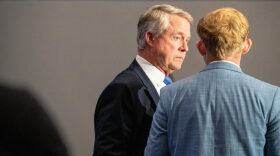 The Republican senator’s residence has been fodder for campaign attacks as he faces a midterm election against Democrat Rev. Adam Hamilton. Marshall's family appears to own more valuable assets in Florida than in Kansas.
 -
 The legislation was intended to establish rules of the road for the crypto sector for the first time. But it suffered a stinging defeat in the Senate on Tuesday, with Republican Missouri Sen. Josh Hawley and Kansas Sen. Jerry Moran voting with every Democrat against the bill.
 -
 The Kansas State Fair offered the first chance to see U.S. Senate candidates Roger Marshall and Adam Hamilton and gubernatorial candidates Ty Masterson and Cindy Holscher square off. The raucous crowd at times shouted down candidates as they spoke.
 -
 In front of a vocal Kansas State Fair audience, Democratic Leawood pastor Adam Hamilton attacked Republican Sen. Roger Marshall on agriculture issues including immigration and beef imports.
 -
 A New York Times report found that Republican U.S. Sen. Roger Marshall, of Kansas, sued hundreds of his patients over medical debt when he was practicing medicine in the western part of the state.
 -
 More than 700 patients were sued by a doctor in western Kansas for medical debt. The doctor is now Republican U.S. Sen. Roger Marshall, who for decades was a practicing obstetrician-gynecologist.

© 2026 Kansas City Public Radio
NPR in Kansas City
Play Live Radio
Next Up:
0:00
0:00
Available On Air Stations


